An MMO Leveling Run, In 40 Minutes · 2026
Runefall
The World of Warcraft leveling climb compressed into a 30 to 45 minute permadeath run. Die and it's gone, and the world rebuilds itself for the next one.
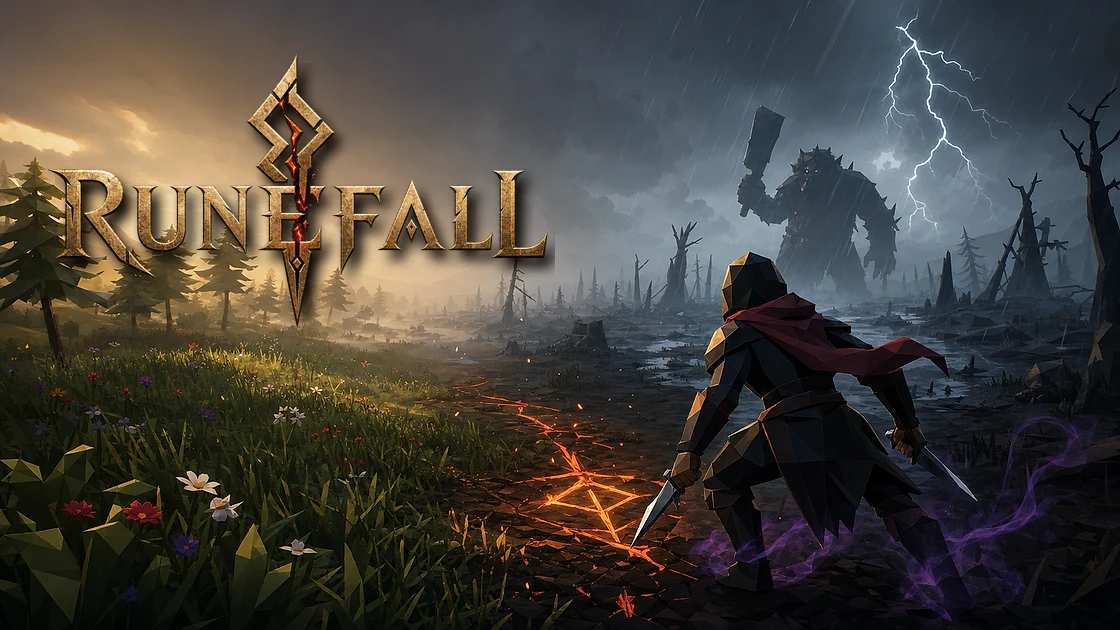
Runefall
The World of Warcraft leveling climb, compressed into a 30 to 45 minute permadeath run. Every expedition rebuilds the world.
Built with: three.js · WebGL · TypeScript · vanilla ES modules · Web Audio API.
Overview
Runefall is an action RPG about the best part of an MMO and none of the waiting. You start as a level 1 Rogue at the edge of the Bramblewood, take quests from the scout at the hub, and work your way toward a boss who will absolutely kill you if you walk into his smash. Pulls matter, because bandits call their friends and three at once ends the run. Levels come fast enough to feel the character change under you. And when you die, you die: the run is over, the character is gone, and what you did with it turns into Legacy Points that make the next one start stronger.
Highlights
- A full leveling arc in one sitting. Level 1 to a boss kill in 30 to 45 minutes, with the pacing of an MMO’s opening zone and none of its downtime.
- Permadeath that pays forward. Dying ends the character, not the progress. Your deeds convert into Legacy Points that unlock account-wide upgrades, so a bad run still moves you.
- Every run is a different map. The world, the rare spawns, the quest reward choices, and the talent drafts all reroll from the seed. Route knowledge helps, but it never carries you.
- Decisions you have to sit with. Pick one of four quest rewards, draft a talent every couple of levels, and decide at the campfire whether to spend your gathered materials on preparations now or save them for the boss.
- Three stages that change how you play. The Bramblewood opens into the storm lashed Stormbreak Expanse, whose capstone awards the key to a compact cave delve. Weather, light, and sightlines shift with each.
Tech and Architecture
The world, characters, and lighting are three.js and WebGL, written in strict TypeScript as vanilla ES modules with no framework. The simulation core is deliberately separated from rendering and fully deterministic, so a seed reproduces a run exactly, and the whole combat, quest, and loot layer is covered by unit tests against that core. Models come through a glTF pipeline with authored source files, the soundtrack and effects run on the Web Audio API with procedurally generated ambience, and the entire HUD, bag, character sheet, and quest log is HTML and CSS layered over the canvas. Render quality tiers let it scale from a laptop to a desktop.
Process
Directed and built end to end: the compression of an MMO leveling arc into a run-based structure, the seeded world generation and reroll systems, the combat and threat design that makes single pulls the correct read, the talent and Legacy progression, the art direction and soundtrack, and the diegetic RPG interface that holds it together.
Gallery
Gallery coming soon
More visuals from this project are on the way.