Event Rental Website · 2026
Palace Party Rental
A premium, quote-first website for a Los Angeles event rental company, built so a 530-piece catalog is easy to browse and easy to inquire about.
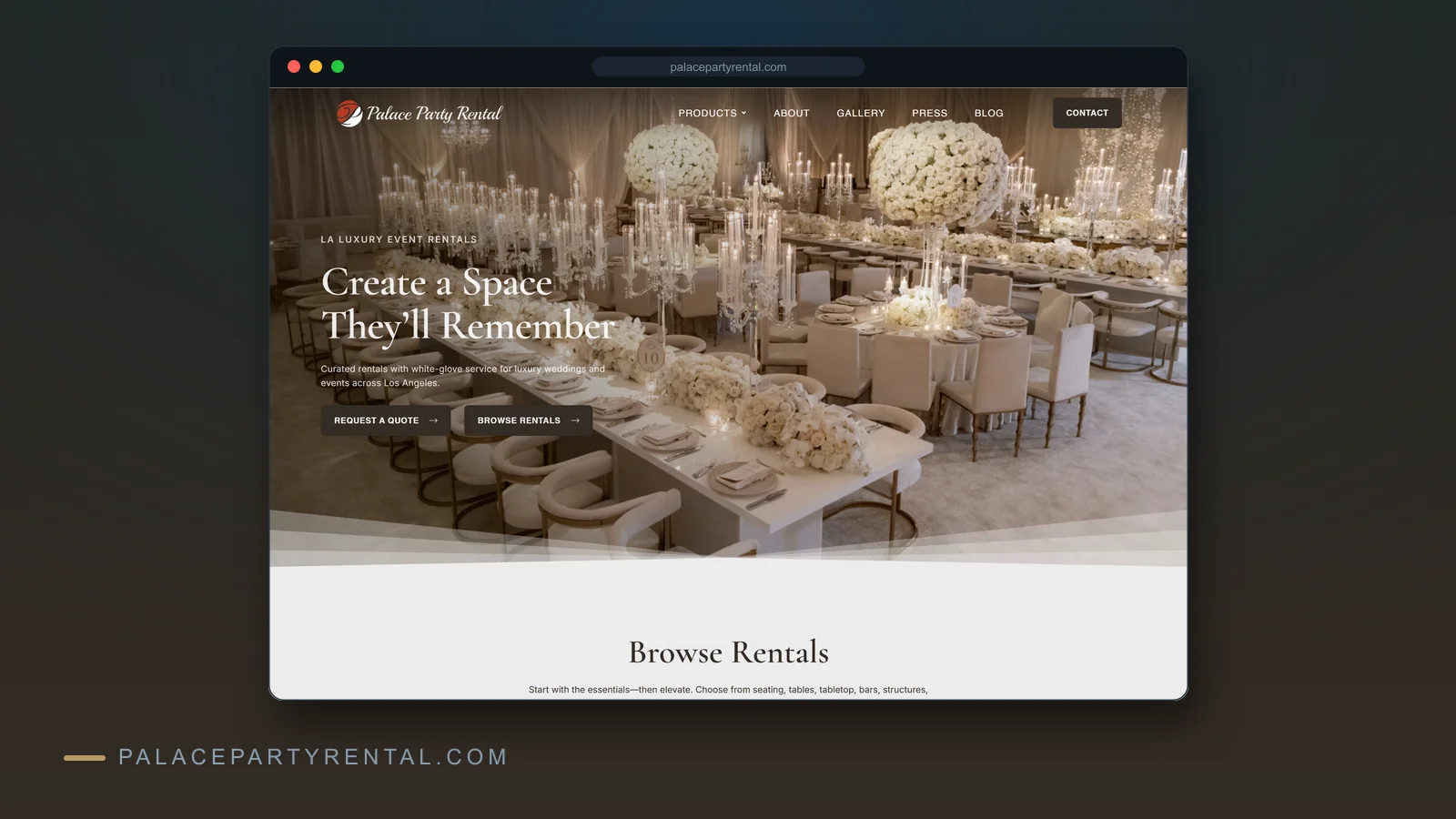
Palace Party Rental
A premium, quote-first website for a Los Angeles event rental company, built so a 530-piece catalog is easy to browse and easy to inquire about.
Live: palacepartyrental.com
Built with: WordPress · WooCommerce · Custom theme and plugins
Overview
Palace Party Rental serves weddings, private celebrations, event planners, and production teams across Los Angeles. The inventory was strong and the business was established, but the website no longer matched either. Products were hard to browse, several page types competed for the same searches, and the site behaved like a store even though Palace does not sell from a cart. I handled strategy, UX and information architecture, catalog architecture, SEO, the WordPress and WooCommerce build, content operations, migration, and launch QA.
The Challenge
The old site ran as three overlapping systems: a product catalog, a pile of hand-built landing pages, and a blog that often chased the same topics as the catalog. Visitors could not tell where to browse, and search engines could not tell which page mattered.
The catalog audit put numbers on it. Of 530 published products, 81 had no category at all, 396 had no short description, and 524 had no full description. Broad buckets like Table Top, Seating, and Other Product held unrelated items, and colors, finishes, materials, and measurements were stored inconsistently.
There was a business-model mismatch on top of that. Availability, quantities, delivery, setup, and venue access all shape a rental quote, so Palace never publishes prices. Standard ecommerce patterns were adding friction instead of helping anyone move forward.
Approach
- Fix the catalog before the interface. Every product was mapped into a clearer future state. Categories were reserved for genuine browse intent, and reusable traits like finish, color, and collection became attributes or filtered views instead of permanent branches of the navigation.
- Name things the way customers do. Seating became Chairs, Lounge Furniture, and Bar Stools. Table Top split into Dinnerware, Glassware, and Flatware. Other Product retired entirely.
- Give every page one job. Categories own commercial browse intent, product pages support item-specific searches, and the blog handles planning and inspiration without competing with either.
- Quote first, everywhere. Pricing, cart behavior, checkout cues, and sale messaging came out of the customer journey. Request Quote became the primary action across navigation, categories, products, and supporting pages, carrying product context into the inquiry.
- Two modes, one system. Editorial and image-led for Home, About, and Event Planning. Practical and scannable for category and product browsing.
Design and Build
The visual system runs on warm neutrals, restrained champagne accents, an expressive serif paired with clean interface type, consistent image framing, and decisive dark calls to action. It reads premium without the ornate wedding-site conventions that would have made a large catalog harder to scan.
The site stayed WordPress-first so the client keeps managing products, media, and content where they already work, with WooCommerce as the catalog layer. Reusable theme logic, shared templates, and tightly scoped merchandising plugins handle repeatable behavior, and targeted production changes shipped as reversible plugins when that was the safest way to touch a live catalog.
Structured CSV and JSON workflows did the heavy lifting instead of hundreds of manual page edits. The main cleanup produced a normalized dataset covering all 530 audited products, 485 catalog updates applied in the staging pass, 31 obsolete or duplicate records pulled from public view, five duplicate products folded into existing variable families, and clean slugs with zero duplicates. Weak areas like Drapery, Linens, Tents, and Outdoor Equipment were rebuilt into real browse destinations rather than left as empty archives.
Content was generated in reviewed batches from verified product names, source descriptions, taxonomy, images, and known specifications, with source data kept for comparison so nothing invented materials or dimensions. Category introductions were written to help customers prepare the details a quote actually needs: guest count, venue, footprint, quantities, and related rentals.
Migration and Launch
Migration planning covered all 817 URLs in the live sitemaps. The pre-launch recheck verified 192 direct redirects to relevant live destinations, one intentional retirement, and zero remaining failures. Template QA confirmed 30 canonical category destinations, 30 matching legacy redirects, and 486 product URLs responding successfully.
Release testing ran across taxonomy, product data, templates, metadata, navigation, redirects, responsive layout, pricing visibility, and quote paths. Seven of seven core pages passed rendered title, description, canonical, and single-H1 checks. All 25 global navigation destinations returned 200 directly. Priority SEO checks passed on all 22 tested URLs, and sampled category and product pages exposed no WooCommerce pricing.
Outcome
The site launched in July 2026. Palace now has a catalog organized around customer intent, a consistent quote-first journey instead of a misleading checkout, taxonomy-backed commercial destinations, a normalized WooCommerce dataset, and repeatable workflows for content, imagery, and global updates. Client response has been positive. Longer-term organic and conversion impact is worth judging once post-launch data accumulates, not projected in advance.
The lesson underneath it: large catalog redesigns are rarely solved by changing the interface. The decisive work was deciding what should be a category, what should be a product, what should become an attribute, and how every meaningful URL would find its way into the new system.